Sourcing Fashion Contact Lens products globally requires more than comparing colors, prices, and minimum order quantities. These lenses may be regulated medical devices, even when buyers purchase them for cosmetic use. A reliable sourcing strategy connects product safety, supplier credibility, clinical guidance, and destination-market requirements.
Look for manufacturers with documented quality systems, traceable production records, and consistent batch controls. Ask for material specifications, sterilization information, packaging details, and independent test reports. Certifications can support evaluation, but they do not automatically prove compliance everywhere. Requirements may differ between the European Union, the United States, the Middle East, and Asian markets. Consult qualified regulatory professionals before importing or selling.
Details matter. Check whether printed packaging matches the actual product. Review lot numbers, expiry dates, lens parameters, and storage instructions. Request samples from several batches, not only one attractive prototype. Color accuracy may change under daylight, studio lighting, and retail displays. Customer comfort can also vary because eye shape, prescription needs, and wearing habits are different.
A polished catalog is not enough. Cheap offers can conceal weak traceability or unsuitable materials. Some assumptions fail during inspection. Responsible buyers should verify authorized distribution channels, confirm optometrist involvement where needed, and prepare a documented recall process. Never source unlabeled or unapproved lenses. The safest global approach balances commercial appeal with evidence, transparency, and consumer protection.
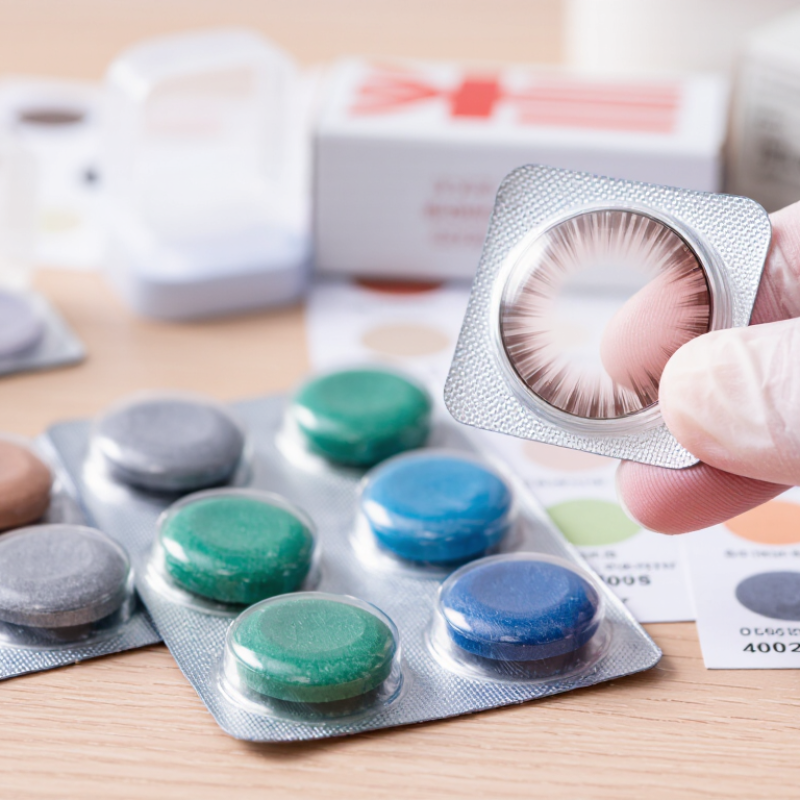
Global sourcing starts with a product definition, not a factory quote. For fashion contact lenses, record the intended wear period, lens diameter, base curve, water content, power range, tint materials, and packaging. Specify whether the lens is corrective or cosmetic. This distinction affects classification, labeling, clinical evidence, and import controls. The U.S. FDA classifies decorative contact lenses as medical devices, even without vision correction (FDA, “Decorative Contact Lenses,” 2024). In the European Union, assess the Medical Device Regulation 2017/745 and applicable conformity route. ISO 18369-1 provides vocabulary and system guidance for contact lenses. Small details matter. A missing lot code can weaken a recall.
Build a compliance file before sampling. Request material specifications, sterility records, shelf-life evidence, biocompatibility testing, and authenticated manufacturing certificates. Check that every package shows power, base curve, diameter, expiry date, lot number, care instructions, and local-language warnings. The CDC reports that about 45 million people in the United States wear contact lenses (CDC, “Contact Lens Wear and Care,” 2023). That figure does not make fashion lenses low-risk. Poor fit can cause abrasion, infection, or reduced vision. Supplier audits should examine cleanroom controls, sealing integrity, complaint handling, and traceability. Do not accept a generic certificate. It may cover another product. I still see teams approving samples from attractive packaging alone. That is a weak decision. Test representative colors and powers, not only the best-looking sample. Requirements should be reviewed by qualified regulatory and eye-care professionals, because local rules can change.
Global fashion contact lens sourcing starts with supplier verification, not catalog browsing. Grand View Research valued the global contact lens market at about US$9.7 billion in 2023. It also projects a 5.8% compound annual growth rate from 2024 to 2030. This growth attracts capable factories and careless intermediaries. A reliable supplier should provide traceable production records, documented material specifications, and a quality management system aligned with ISO 13485. Ask for recent audit results. Do not accept vague certificates.
Samples reveal more than polished presentations. Check lens diameter, base curve, tint consistency, packaging seals, and labeling accuracy. Independent laboratories can test sterility, oxygen transmission, and material safety. The United States Food and Drug Administration classifies decorative lenses as medical devices, requiring a prescription in the United States. Other markets apply different rules, so suppliers must show country-specific compliance knowledge. They should explain registration duties before discussing volume discounts.
Paperwork matters. So does response speed. During supplier interviews, request batch numbers, complaint procedures, recall plans, and storage instructions. The International Organization for Standardization states that ISO 13485 focuses on medical-device quality systems, including risk-based controls and traceability. A supplier refusing a factory visit deserves caution. I have seen buyers overvalue low unit prices and underestimate replacement costs. That judgment is understandable, but incomplete. Test the first shipment under realistic warehouse conditions, including heat and humidity exposure, before scaling production.
Sourcing fashion contact lenses globally requires more than attractive colors and competitive prices. These products sit directly on the eye, so quality checks must begin at the factory. Ask whether the facility follows a documented quality system, such as ISO 13485, and request current audit records. Certification alone is not enough. Review its scope, issuing body, and expiration date.
Inspect samples under bright light. Look for uneven tinting, rough edges, bubbles, or particles inside sealed packages. A dependable manufacturer should provide lot numbers, material specifications, sterility records, and test results for optical power and packaging integrity. Independent laboratory reports can confirm whether the lens material and pigments remain stable during storage. Ask how rejected batches are isolated and recorded. Small details matter.
Regulatory acceptance differs by market. Before ordering, verify each destination’s rules for medical devices, labeling, prescription handling, and importer responsibility. Packaging should show clear instructions, expiry dates, batch identification, and storage conditions in the required language. Do not rely on translated claims without checking the original technical documents. Request the evidence.
Supplier communication also reveals practical reliability. Can the team explain sterilization controls without vague answers? Can it trace one carton back to production records? I have found that fast replies sometimes hide weak documentation. That deserves a second review. A cautious sourcing process protects buyers, distributors, and wearers from preventable eye injuries.
| Evaluation Dimension | What to Verify | Relevant Global Requirement or Standard | Acceptable Evidence | Sourcing Risk Indicator |
|---|---|---|---|---|
| Regulatory Classification | Confirm whether the destination market classifies fashion or decorative lenses as medical devices, vision-correction devices, or another regulated product category. | Classification varies by jurisdiction. In several major markets, non-corrective decorative lenses are regulated similarly to corrective contact lenses. | Written classification from the applicable medical-device or health authority, plus product registration or market-authorization records where required. | Supplier claims that decorative lenses are automatically exempt because they have no prescription power. |
| Quality Management System | Assess whether the manufacturing site operates a documented system covering design, production, traceability, complaints, corrective actions, and supplier controls. | ISO 13485 is the internationally recognized quality-management standard specifically intended for medical devices. | Current ISO 13485 certificate, certification scope, issuing body, site address, certificate number, and validity dates. Verify the certificate independently. | A generic ISO certificate that does not cover medical devices or the actual production facility. |
| Manufacturing-Site Verification | Confirm that the listed factory, subcontractors, and packaging location match the supplier’s regulatory and quality documents. | Regulated-device supply chains require controlled manufacturing processes and traceable responsibilities. | Recent third-party audit report, facility address, production-flow records, subcontractor list, and a live or independent factory audit. | Documents identify a trading office but provide no evidence for the actual lens-production site. |
| Material Safety | Check the exact lens polymer, water content, pigments, additives, surface treatments, and any substances that contact the eye. | Materials should be evaluated for biological safety under ISO 10993 principles and applicable local medical-device requirements. | Material specifications, supplier declarations, extractables or leachables assessment where relevant, and biological-evaluation documentation. | Undisclosed pigments, inks, adhesives, coatings, or material substitutions between production batches. |
| Optical and Dimensional Accuracy | Measure base curve, diameter, center thickness, power where applicable, edge profile, and tint alignment against approved specifications. | Contact-lens performance should conform to the approved product specification and applicable recognized contact-lens standards, including ISO 18369 series where relevant. | Batch inspection records, calibrated measuring equipment, approved drawings, tolerance limits, and independent sample testing. | Large variation in diameter, curvature, cosmetic pattern placement, or corrective power between samples. |
| Oxygen Transmission and Wear Performance | Review oxygen permeability or transmissibility, recommended wearing schedule, hydration behavior, surface wettability, and dehydration resistance. | Performance claims must be supported by validated test methods and the product’s approved labeling; cosmetic appearance does not establish safe wear performance. | Test reports identifying methods, sample sizes, acceptance criteria, laboratory details, and results for the final commercial formulation. | Marketing focuses only on color or appearance and provides no validated wear-performance data. |
| Microbiological Control | Determine whether lenses are supplied sterile or under another authorized microbiological-control process, and verify environmental monitoring. | Sterile products generally require validated sterilization, bioburden control, and ongoing monitoring. ISO 11737 principles are commonly used for sterilization-related microbiological testing. | Sterilization validation, routine cycle records, bioburden results, environmental-monitoring records, and sterility or microbial-limit test results as applicable. | No batch-specific sterilization records or unclear claims such as “clean” without a defined microbiological specification. |
| Packaging Integrity | Inspect blister seals, container closure, solution volume, leakage resistance, label legibility, and protection from contamination or physical damage. | Packaging must maintain product safety and required sterility throughout the labeled shelf life and specified transport conditions. | Seal-strength and integrity tests, transport simulation, stability data, packaging specifications, and retained-sample records. | Loose seals, leaking containers, missing lot information, or packaging that changes without documented validation. |
| Shelf Life and Stability | Verify that the expiry date is supported by real-time or appropriately justified accelerated stability studies for the final packaged product. | Stability programs should evaluate chemical, physical, microbiological, packaging, and performance characteristics over the claimed shelf life. | Stability protocol, time-point results, storage conditions, expiry rationale, and evidence covering the commercial packaging configuration. | Expiry dates are printed without supporting data or are extended after production without a documented assessment. |
| Labeling and Instructions for Use | Check intended use, replacement schedule, base curve, diameter, power, lot number, expiry date, storage conditions, warnings, and wearing instructions. | Labeling must meet the destination market’s language, medical-device, advertising, and consumer-safety rules. | Regulatory label review, approved instructions for use, translated artwork, and consistency between packaging and technical documentation. | Missing warnings, incomplete parameters, inaccurate translations, or instructions encouraging sharing or overnight wear. |
| Traceability and Batch Control | Ensure every shipment can be linked to raw materials, production records, inspection results, packaging components, and distribution records. | Medical-device quality systems generally require documented identification and traceability appropriate to product risk. | Unique lot or batch coding, device history records, certificate of analysis, retention samples, and documented recall procedures. | A shipment contains mixed lot codes or the supplier cannot identify the production date and source of materials. |
| Post-Market Surveillance | Evaluate how the supplier records complaints, adverse events, returns, corrective actions, and field-safety notices. | Regulated-device manufacturers are generally expected to maintain complaint handling and corrective or preventive action processes. | Complaint procedure, response-time targets, trend reports, CAPA records, recall workflow, and escalation contacts. | Supplier has no formal complaint channel or treats eye irritation and damaged lenses as ordinary customer-service issues only. |
| Destination-Market Authorization | Confirm importer, responsible economic operator, registration, conformity assessment, and licensing requirements before shipment. | Requirements differ by market and may include national registration, authorized representatives, conformity documentation, and import controls. | Market-specific regulatory checklist, registration confirmation, conformity documentation, importer license, and customs classification review. | Supplier proposes shipping first and “handling registration later,” or cannot identify the legally responsible importer. |
| Independent Product Testing | Use an independent, competent laboratory to test production samples rather than relying solely on supplier-controlled reports. | Testing should use validated methods and laboratories capable of demonstrating technical competence; ISO/IEC 17025 accreditation is a strong indicator. | Laboratory accreditation scope, chain of custody, sample identification, test method, raw results, and comparison with approved specifications. | Reports are undated, unsigned, unrelated to the supplied lot, or issued by a laboratory with no verifiable scope. |
| Commercial and Ethical Due Diligence | Review production capacity, minimum order quantity, lead time, change-control policy, labor practices, and willingness to provide complete compliance records. | Commercial claims should not override product-safety, labor, customs, or medical-device obligations. | Supplier questionnaire, audit results, written quality agreement, change-notification clause, social-compliance assessment, and documented approval process. | Unusually low pricing, pressure to skip testing, undocumented formula changes, or refusal to sign quality and recall responsibilities. |
How to Source Fashion Contact Lenses Globally?
International sourcing starts with landed cost, not factory price.
Fortune Business Insights estimated the global contact lens market above US$9 billion in 2023. That scale increases supplier choices, but also creates uneven quality and pricing. Request a written quotation showing lens cost, prescription range, packaging, inspection, and shipping terms. Compare EXW, FOB, and DDP carefully. A low unit price can hide expensive customs handling, storage, or rejected samples.
Samples need a controlled process.
Ask for identical batches, material specifications, water content, diameter, base curve, and production dates. Keep one sealed sample for future comparison. It sounds basic. It prevents arguments. The U.S. Food and Drug Administration classifies decorative lenses as medical devices, while European requirements also demand responsible conformity assessment. Requirements differ by destination, so confirm them with an authorized customs broker before payment. I once underestimated documentation time; the shipping delay cost more than the samples.
For transport, calculate duties using the correct tariff classification and declared transaction value.
Request commercial invoices, packing lists, certificates, and product documentation before dispatch. The World Bank’s 2023 Logistics Performance Index shows major differences in customs efficiency among trading markets. That gap affects delivery reliability. Build a 10–20% contingency for freight changes, inspections, and currency movement. International pricing is never perfectly stable. A transparent supplier should explain every adjustment, even when the explanation is uncomfortable.
Sourcing fashion contact lenses globally requires more than comparing quotations. A durable supplier partnership begins with verified manufacturing experience, traceable materials, and clear quality responsibilities. Request facility records, product specifications, batch documentation, and evidence of applicable local approvals. Review sterilization controls, packaging integrity, color consistency, and shelf-life testing. Ask for samples from several production lots, not one polished set. Small differences matter.
A practical partnership uses written service levels and scheduled reviews. Define response times for defects, document changes, delivery delays, and customer complaints. Keep retained samples and match each shipment to its batch number. Remote audits help, but independent inspections provide stronger evidence. I have learned that friendly communication can hide weak controls. Trust needs records. Supplier evaluations should include quality staff, regulatory advisers, and logistics specialists.
Market oversight must continue after launch. Monitor returns, discomfort reports, packaging damage, and unusual sales patterns by country. Compare these signals with warehouse temperature logs and delivery data. Recheck labels when regulations or language requirements change. Train local sales teams to avoid medical promises and report safety concerns quickly. A shared dashboard can reveal repeated issues, although data may be incomplete. That limitation deserves attention. Review suppliers quarterly, then adjust orders when evidence changes. A lower price is not a reliable saving if rework, recalls, or delayed investigations follow.
Request production records, material specifications, audit results, and a documented quality management system. Vague certificates are not enough.
Check diameter, base curve, color consistency, package seals, and label accuracy. Small differences can signal larger production problems.
Laboratories can test sterility, oxygen transmission, and material safety. Supplier claims may sound convincing, but evidence matters more.
The supplier should explain registration, prescription, labeling, and sales requirements for each target market. Rules differ by country.
Request batch numbers, complaint procedures, recall plans, storage instructions, shelf-life data, and product specifications. Keep copies.
Yes, when practical. A factory visit or independent inspection can reveal weak controls, incomplete records, or poor packaging areas.
Test it under realistic warehouse conditions, including heat and humidity exposure. Review packaging, color, labeling, and batch traceability.
Use written service levels, scheduled reviews, retained samples, and clear response times for defects or delivery delays. Friendly communication is not proof.
Track returns, discomfort reports, damaged packages, unusual sales patterns, and warehouse temperature records. Data may be incomplete.
Review suppliers quarterly and adjust orders when evidence changes. A lower price may disappear after rework, recalls, or delayed investigations.
Sourcing Fashion Contact Lens products globally requires a structured approach that balances design appeal, consumer safety, and regulatory compliance. Buyers should first define essential requirements, including lens materials, prescription or non-prescription options, colors, patterns, packaging, labeling, and target-market standards. Reliable suppliers can be identified through transparent communication, verifiable business records, production experience, and willingness to provide samples and documentation. Product evaluation should include comfort, optical performance, hygiene controls, durability, and relevant manufacturing certifications.
International purchasing also involves comparing total costs, minimum order quantities, sample fees, lead times, shipping methods, import procedures, and customs documentation. Clear agreements can reduce misunderstandings regarding quality specifications, inspection procedures, payment terms, and replacement policies. After selecting a supplier, buyers should maintain regular communication, monitor batch consistency, review customer feedback, and periodically reassess compliance and market expectations. Building a responsible, long-term partnership helps ensure dependable supply, protects consumers, and supports sustainable growth in the global Fashion Contact Lens market.
